Forex fundamental analysis (Part 6): the US Dollar Index (DXY), monetary policy and fiscal policy
The US Dollar Index (DXY) measures the dollar against a basket of six currencies. This part covers what is in the basket, how it relates to currency pairs and gold, and the difference between monetary and fiscal policy (plus QE and QT).
Contents
The dollar is on one side of roughly 90% of forex trades. So if you know whether the dollar is broadly strong or weak, you have half the answer for most pairs. The main tool for this is the US Dollar Index (DXY).
What is the DXY?
The DXY shows the dollar’s value against a basket of six major currencies. It was set up in 1973 with a base of 100, so a reading of 105 means the dollar is about 5% stronger than that base.
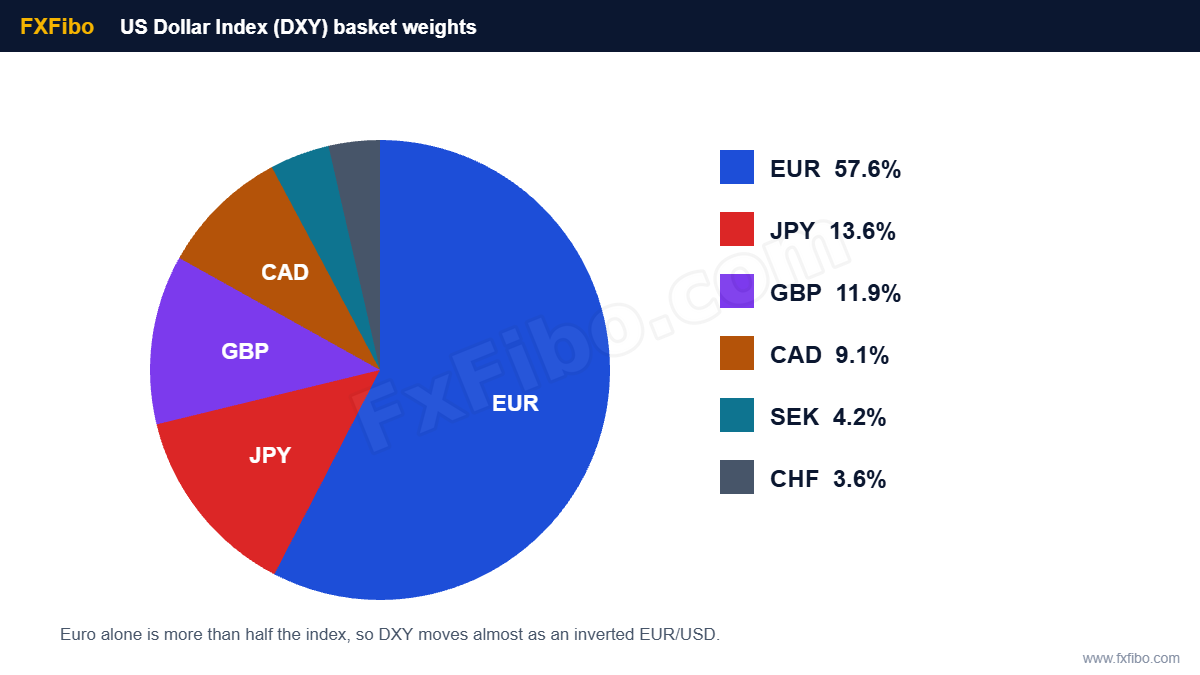
| Currency | Weight |
|---|---|
| Euro (EUR) | 57.6% |
| Japanese yen (JPY) | 13.6% |
| British pound (GBP) | 11.9% |
| Canadian dollar (CAD) | 9.1% |
| Swedish krona (SEK) | 4.2% |
| Swiss franc (CHF) | 3.6% |
Key point: more than half of the DXY is the euro. That is why the DXY and EURUSD move almost as mirror images.
How the DXY relates to other markets
- EURUSD, GBPUSD: strong inverse relationship. When the DXY rises, these pairs fall.
- USDJPY, USDCAD, USDCHF: direct relationship, because the dollar is the base currency.
- AUDUSD and NZDUSD: not in the basket, but because the dollar is the other side, they usually fall when the DXY rises.
- Gold: priced in dollars and usually inverse to the DXY. In fear-driven periods or heavy central-bank buying the link can break for a while.
- Oil: a weaker and less stable link; supply and demand matter more.
The original course deck listed AUD, NZD, gold and oil as "DXY currencies". To be precise, they are not in the basket; they only react to the dollar’s moves.
How to use the DXY
- Before analysing any dollar pair, check the DXY on the same timeframe.
- If the DXY is at a major resistance, be more careful buying USDJPY or selling EURUSD.
- If your signal says buy EURUSD but the DXY is in a strong uptrend, you are trading against the main flow.
Monetary policy vs fiscal policy
Two forces steer the economy and both affect the currency, but they come from different places.
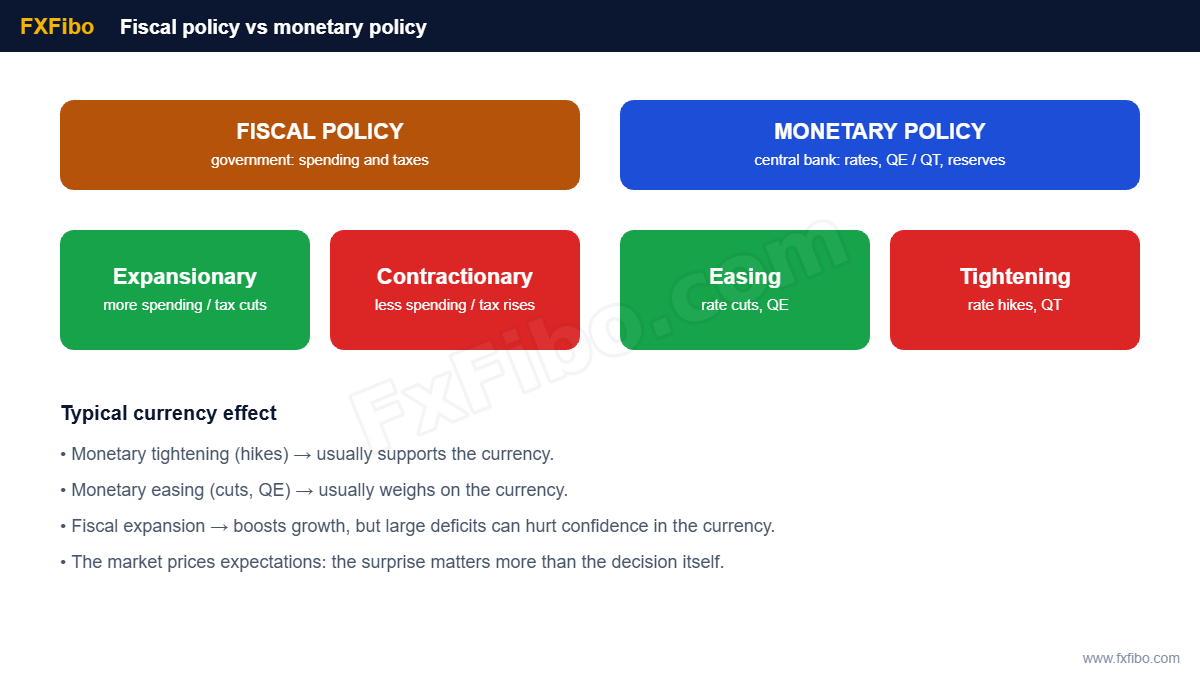
Monetary policy
- Who: the central bank (the Federal Reserve, the ECB and so on).
- Tools: interest rates, buying or selling bonds, reserve requirements, forward guidance.
- Goal: control inflation and support employment.
- Effect on the currency: direct and fast. A hike or a hawkish tone usually strengthens the currency.
Fiscal policy
- Who: the government and parliament.
- Tools: taxes and government spending (budgets, subsidies, infrastructure).
- Effect on the currency: more indirect and slower. More spending lifts growth, but also raises deficits and debt, which can weigh on the currency over time.
QE and QT
- Quantitative easing (QE): the central bank buys bonds and injects money into the economy. More money supply → usually negative for the currency.
- Quantitative tightening (QT): the central bank lets bonds run off or sells them and drains money from the system → usually positive for the currency.
Course wrap-up
Across these six parts you saw that:
- A currency ultimately follows the strength of its economy and rate expectations.
- Inflation and central-bank decisions have the biggest impact.
- Growth (GDP, retail sales, PMI) and jobs (NFP, unemployment) complete the picture.
- Housing is an early warning.
- The DXY is the dollar’s overall compass.
Most important of all: the market doesn’t react to the number, it reacts to the gap between the number and expectations. Always compare the actual with the forecast, and check the economic calendar before every trade.
The complete forex fundamental analysis series
- Part 1: What fundamental analysis is and what moves currencies
- Part 2: Inflation, interest rates and central banks
- Part 3: Growth data: GDP, retail sales, production and PMI
- Part 4: Jobs data: NFP, unemployment and jobless claims
- Part 5: Housing data and how it moves currencies
- Part 6: The US Dollar Index (DXY) and fiscal vs monetary policy (you are here)
This article is educational and is not investment advice.
Questions? Telegram support @fibonacci_chart
Forex and CFD trading carries a high level of risk due to leverage and you may lose more than your initial capital. Content on this site is educational and not investment advice.
Get curated analysis every Friday
5 key events, 2 curated analyses and one tool or lesson — one-click unsubscribe.