Forex fundamental analysis (Part 4): NFP, unemployment and jobless claims, how to read jobs data
The US jobs report (NFP) is one of the most volatile moments of the month. This part shows how to read NFP, the unemployment rate, wages and jobless claims, and which numbers count as "good".
Contents
If there is one day a month when traders sit in front of their screens waiting for a single number, it is the first Friday: US jobs day. Gold, the dollar and indices can move hundreds of pips in minutes.
The reason is simple: the Fed has a dual mandate, stable prices and maximum employment. So jobs data feed straight into the rate decision.
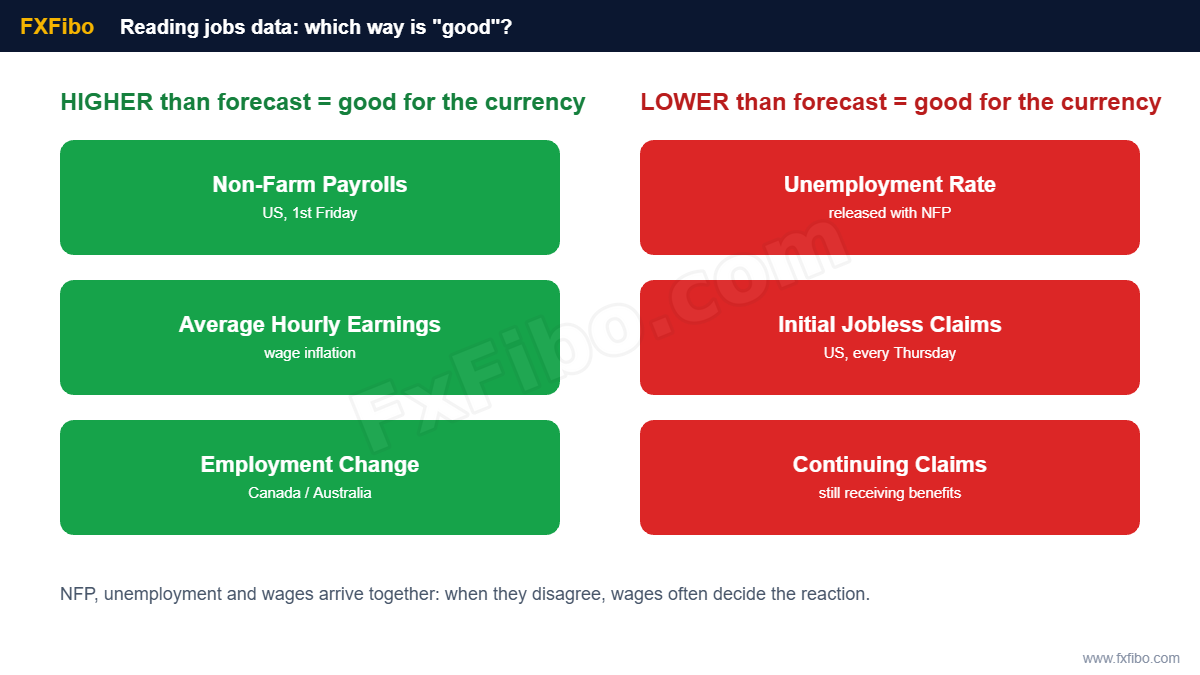
Non-Farm Payrolls (NFP)
The change in the number of people employed in the US over the previous month, excluding farm workers and a few other groups such as household staff.
- Timing: usually the first Friday of each month, for the previous month.
- Effect: higher than forecast → usually positive for the dollar.
- Note: the previous two months are revised in every report. Sometimes the revisions turn out to matter more than the headline.
Unemployment rate
The share of the labour force looking for work but without a job. Released with NFP.
- Effect: lower than forecast → positive for the currency.
Average hourly earnings
Part of the same NFP report and very important these days. Fast wage growth means more inflation pressure and a higher chance of rate hikes.
When NFP and wages disagree (weak jobs but strong wages, say), the market reaction often follows the wage number.
Jobless claims
- Initial claims: the number of people filing for unemployment benefits for the first time.
- Continuing claims: people still receiving benefits.
- Timing: every Thursday, for the week ending the previous Saturday.
- Effect: lower than forecast → positive for the dollar.
Because it is weekly, it gives the fastest picture of the labour market. For example, in the week to 21 November 2026, initial claims fell to 189,000, below the 200,000 forecast, which supported the dollar.
Employment change in Canada and Australia
The same idea as NFP, for Canada and Australia.
- Canada: usually released at the same time as US NFP, on the first Friday of the month, so CAD gets hit twice that day.
- Australia: around the middle of the month.
- Effect: higher than forecast → positive for the currency.
The ADP report
An estimate of US private-sector employment from payroll firm ADP. It usually comes two days before NFP, and the market treats it as a preview, although it doesn’t always point the same way.
Practical tips for NFP day
- Don’t jump in during the first minutes. Spreads widen and price can hit both sides.
- Look at revisions and wages too, not just the headline.
- Trade smaller. A normal stop can be filled with slippage in those minutes. Recalculate your size with the position size calculator.
- Know the exact time: 8:30 a.m. New York time. Check your local time in the economic calendar.
The complete forex fundamental analysis series
- Part 1: What fundamental analysis is and what moves currencies
- Part 2: Inflation, interest rates and central banks
- Part 3: Growth data: GDP, retail sales, production and PMI
- Part 4: Jobs data: NFP, unemployment and jobless claims (you are here)
- Part 5: Housing data and how it moves currencies
- Part 6: The US Dollar Index (DXY) and fiscal vs monetary policy
This article is educational and is not investment advice.
Questions? Telegram support @fibonacci_chart
Forex and CFD trading carries a high level of risk due to leverage and you may lose more than your initial capital. Content on this site is educational and not investment advice.
Get curated analysis every Friday
5 key events, 2 curated analyses and one tool or lesson — one-click unsubscribe.