Forex fundamental analysis (Part 3): GDP, retail sales, production and PMI, the growth indicators
Growth decides how much room a central bank has to raise or cut rates. This part covers the key growth indicators: GDP, retail sales, industrial production, durable goods, PMI, consumer confidence and the trade balance.
Contents
Inflation tells a central bank "you need to raise rates". Growth tells it whether it can. A fast-growing economy can handle hikes; a weak one can’t.
This part walks through the indicators that show how strong growth really is.
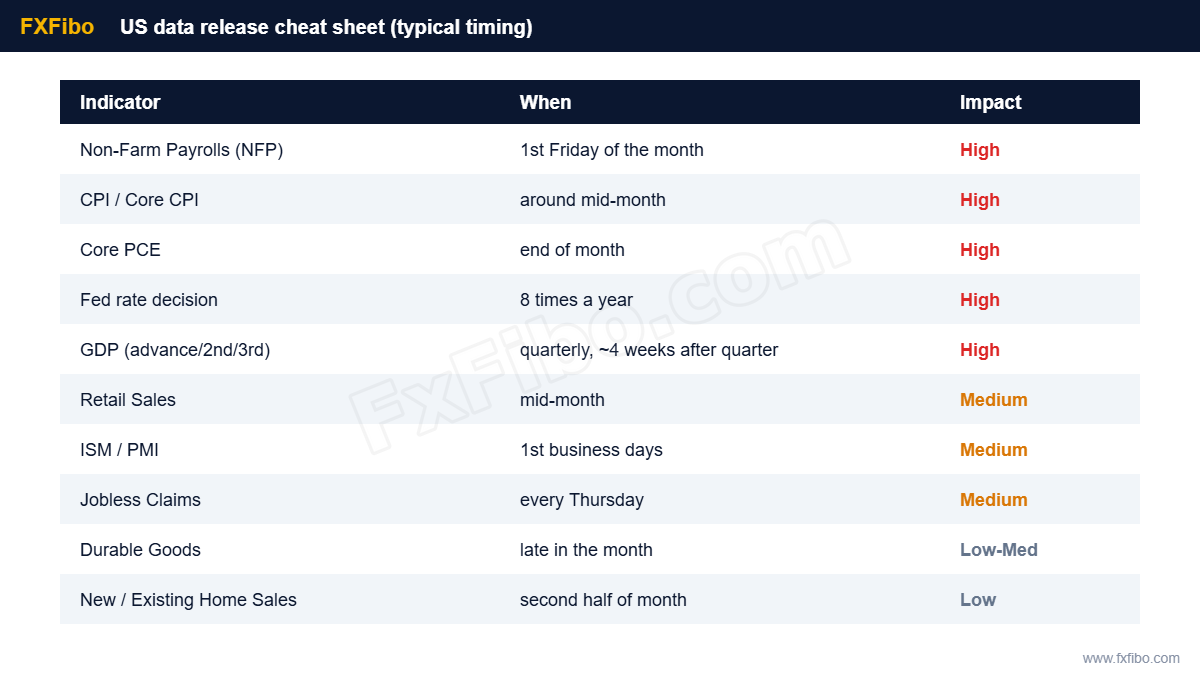
Gross domestic product (GDP)
GDP is the total value of goods and services a country produces over a period. It is the broadest measure of economic activity.
- Timing: quarterly. The US publishes three estimates (advance, second and third); the first comes about 4 weeks after the quarter ends.
- How it’s reported: the US reports quarterly growth at an annualised rate; most countries report quarter-on-quarter change.
- What is healthy? For advanced economies, annual growth of around 2–3% is usually healthy and sustainable. Much faster growth can be inflationary.
- Recession: two consecutive quarters of negative growth is the common (if unofficial) definition.
- Effect: higher than forecast → usually positive for the currency.
Example: on 25 November 2026, the US advance Q3 GDP came in at 4.3%, well above the 3.5% forecast, supporting expectations of a Fed hike.
Retail sales
The change in the total value of sales at the retail level. It is the first look at consumer spending, and in the US consumption is about two-thirds of the economy.
- Core retail sales: the same measure excluding autos, because car sales are volatile.
- Timing: monthly, around the middle of the following month.
- Effect: higher than forecast → positive for the currency.
Industrial and manufacturing production
- Industrial production: the change in output from factories, mines and utilities.
- Manufacturing production: factories only; the largest part of industrial production and quick to react to economic conditions.
- Timing: monthly, around the middle of the following month.
- Effect: higher than forecast → positive.
Durable goods orders
Orders for goods meant to last more than three years, such as machinery and aircraft. It is a leading indicator: today’s orders are tomorrow’s production.
- Core durable goods: excludes transportation, because aircraft orders swing the headline number wildly.
- Timing: monthly, late in the following month.
Purchasing Managers’ Index (PMI)
A monthly survey of purchasing managers on output, new orders, employment, prices and delivery times.
- The 50 line: above 50 means expansion, below 50 contraction.
- Two key versions: ISM in the US and S&P Global PMIs in most other countries.
- Timing: early in the month (final) and late in the month (flash).
- Effect: leading and market-moving; higher than forecast is positive.
Consumer confidence
- University of Michigan (UoM): published twice, preliminary and final, about two weeks apart. Its inflation-expectations component also matters to the Fed.
- Conference Board: the other main US consumer confidence index, at the end of each month.
Trade balance
The difference between the value of exports and imports. A positive figure (surplus) means exports exceed imports and foreign demand for the currency is higher. It matters more for export-driven economies such as Australia, Canada and Japan.
Summary of effects
| Indicator | Leading or lagging | "Better than forecast" means |
|---|---|---|
| GDP | Coincident | Higher number |
| Retail sales | Coincident | Higher number |
| Industrial production | Coincident | Higher number |
| Durable goods | Leading | Higher number |
| PMI | Leading | Higher number |
| Consumer confidence | Leading | Higher number |
| Trade balance | Coincident | Bigger surplus or smaller deficit |
We log the release times for all of these every week in the site’s economic calendar.
The complete forex fundamental analysis series
- Part 1: What fundamental analysis is and what moves currencies
- Part 2: Inflation, interest rates and central banks
- Part 3: Growth data: GDP, retail sales, production and PMI (you are here)
- Part 4: Jobs data: NFP, unemployment and jobless claims
- Part 5: Housing data and how it moves currencies
- Part 6: The US Dollar Index (DXY) and fiscal vs monetary policy
This article is educational and is not investment advice.
Questions? Telegram support @fibonacci_chart
Forex and CFD trading carries a high level of risk due to leverage and you may lose more than your initial capital. Content on this site is educational and not investment advice.
Get curated analysis every Friday
5 key events, 2 curated analyses and one tool or lesson — one-click unsubscribe.