Forex fundamental analysis (Part 1): what really moves currencies?
Traders keep asking where fundamental analysis fits into their trading. Part 1 of this series covers what fundamentals are for, what an economic indicator is, and the nine main forces that set a currency’s value.
Contents
One question comes up with almost every trader: "I trade the charts, so what do I need fundamental analysis for?"
The short answer: the chart tells you where price is and where it is likely to go; fundamentals explain why. And when the two point the same way, trades tend to run more cleanly.
Where to use fundamentals
In practice, fundamentals earn their keep in three places:
- To confirm your technical view. If the gold chart is bearish and the market expects the Fed to hike, you have two independent reasons pointing the same way.
- Around major news. In the minutes before and after rate decisions, inflation data or NFP, price can blow through technical levels. Knowing the calendar tells you when to stand aside.
- For a medium and long-term view. Multi-month trends almost always have a fundamental driver behind them, such as the interest-rate gap between two countries.
What is an economic indicator?
The simplest definition: a number published to show the state of one part of the economy. Inflation, jobs, output, retail sales and dozens more.
By timing, indicators fall into three groups:
- Leading: move before the economy turns, such as PMIs, building permits and durable goods orders.
- Coincident: move with the economy, such as industrial production and personal income.
- Lagging: confirm a change after it happens, such as the unemployment rate and core inflation.
Together they show which stage of the cycle the economy is in and where it is heading.
Nine forces that set a currency’s value
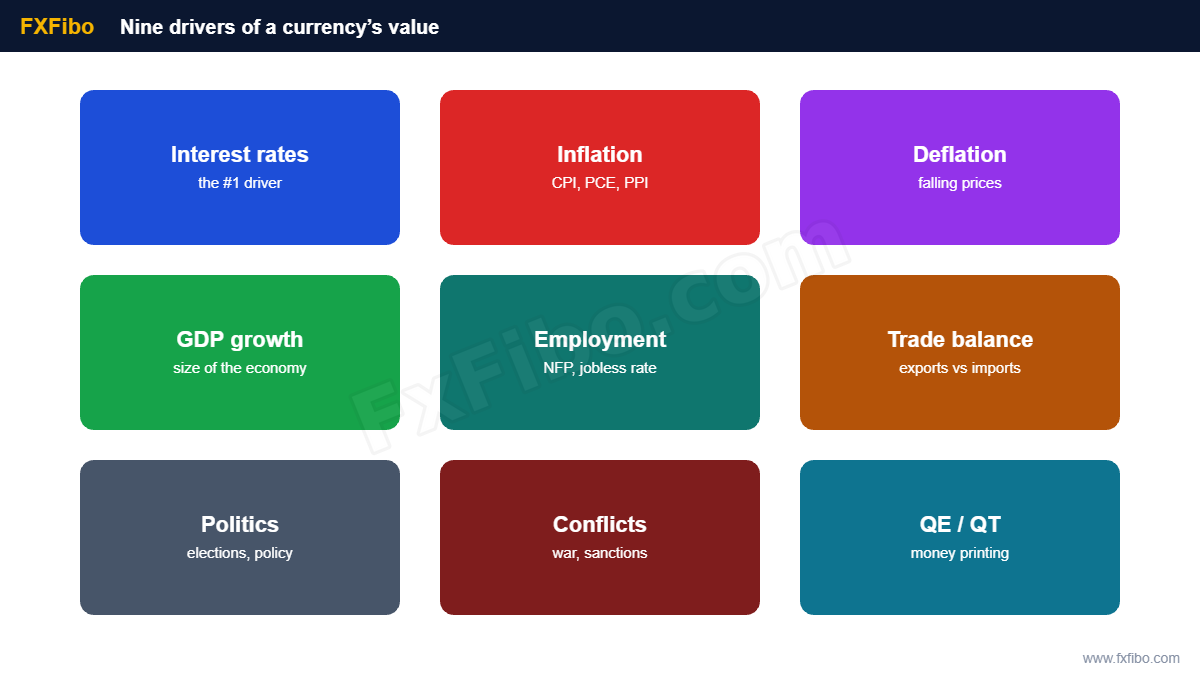
| Driver | In plain English |
|---|---|
| Interest rates | The biggest driver. Higher rates attract capital to the currency. |
| Inflation | High inflation usually pushes the central bank to raise rates. |
| Deflation | Falling prices; a sign of weak demand and usually a prelude to rate cuts. Not the same as recession. |
| GDP growth | The overall health of the economy. |
| Employment | A strong jobs market means more spending and more inflation pressure. |
| Trade balance | Exports minus imports; foreign demand for the country’s currency. |
| Political events | Elections, changes of government, trade policy and tariffs. |
| Military conflicts | Capital flight into safe havens such as the dollar, franc, yen and gold. |
| Quantitative easing (QE) and tightening (QT) | The central bank printing money to buy bonds, or doing the reverse. |
The golden rule: the surprise matters, not the number
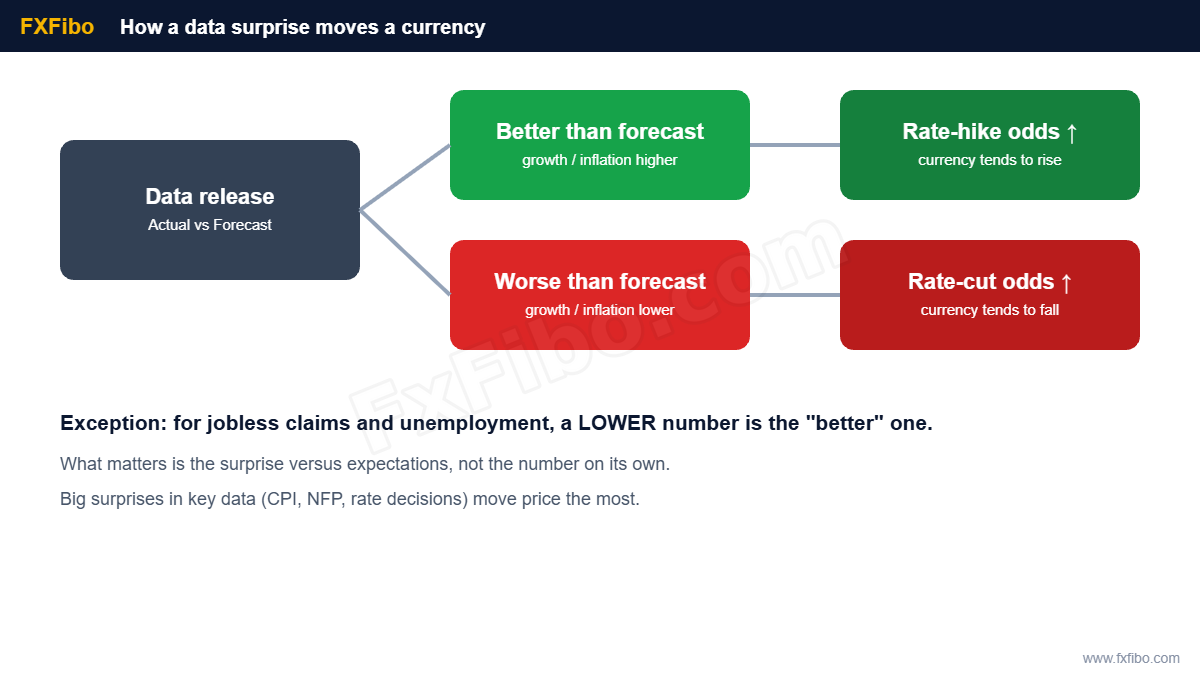
Before any release, the market has already priced in the forecasts. So what moves price is not the number itself but the surprise: the gap between the actual figure and the forecast.
- Better than forecast (higher growth or inflation) → higher rate-hike expectations → usually positive for the currency.
- Worse than forecast → rate-cut expectations → usually negative for the currency.
- Exception: for unemployment and jobless claims, a lower number is the better one.
Who sets interest rates?
Central banks. These eight have the biggest influence on the forex market:
| Central bank | Currency |
|---|---|
| Federal Reserve (Fed) | USD |
| European Central Bank (ECB) | EUR |
| Bank of England (BoE) | GBP |
| Bank of Japan (BoJ) | JPY |
| Swiss National Bank (SNB) | CHF |
| Bank of Canada (BoC) | CAD |
| Reserve Bank of Australia (RBA) | AUD |
| Reserve Bank of New Zealand (RBNZ) | NZD |
See current rates and next meeting dates on the site’s central banks page, and release times in the economic calendar.
In the next part we turn to the main engine of currency moves: inflation and interest rates.
The complete forex fundamental analysis series
- Part 1: What fundamental analysis is and what moves currencies (you are here)
- Part 2: Inflation, interest rates and central banks
- Part 3: Growth data: GDP, retail sales, production and PMI
- Part 4: Jobs data: NFP, unemployment and jobless claims
- Part 5: Housing data and how it moves currencies
- Part 6: The US Dollar Index (DXY) and fiscal vs monetary policy
This article is educational and is not investment advice.
Questions? Telegram support @fibonacci_chart
Forex and CFD trading carries a high level of risk due to leverage and you may lose more than your initial capital. Content on this site is educational and not investment advice.
Get curated analysis every Friday
5 key events, 2 curated analyses and one tool or lesson — one-click unsubscribe.