Forex fundamental analysis (Part 2): inflation, interest rates and central banks
Interest rates are the biggest driver of currencies, and inflation is the main reason they change. This part covers the inflation indicators (CPI, PCE, PPI), the rate cycle and the central-bank events that move markets.
Contents
If you only learn one thing about fundamentals, make it this: money flows to where it earns more. When a central bank raises rates, holding that currency becomes more attractive and demand for it rises.
And central banks watch one number more than any other: inflation.
The interest-rate cycle
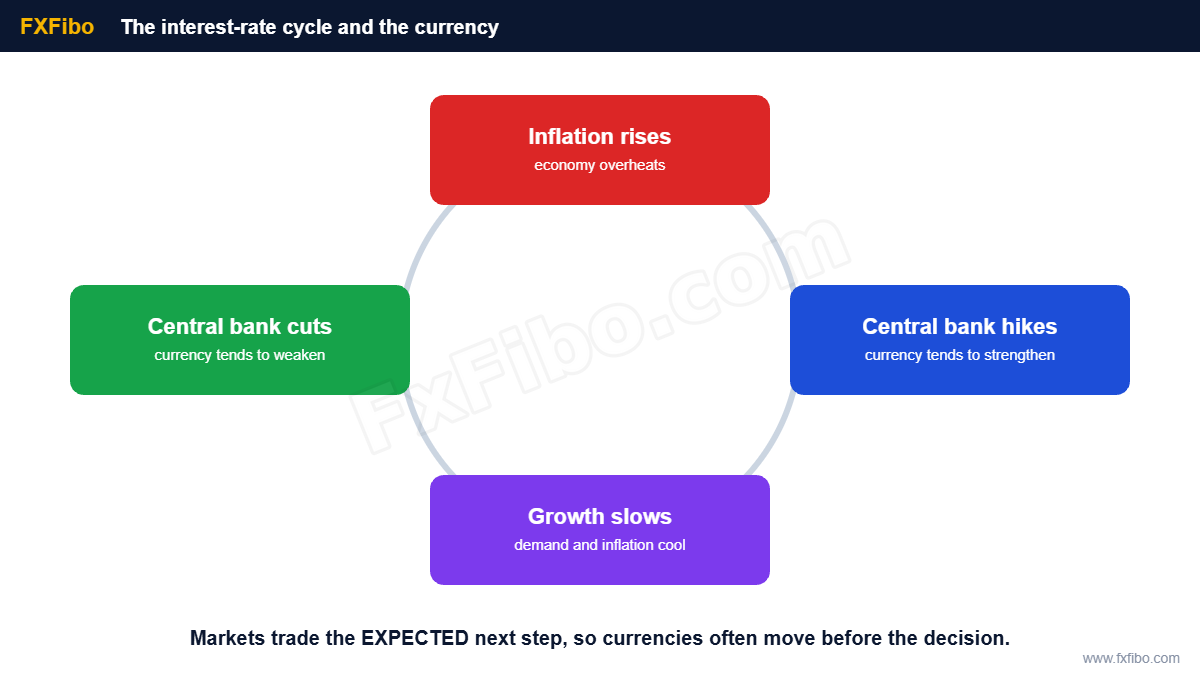
- The economy heats up and inflation rises.
- The central bank hikes rates to cool inflation; the currency usually strengthens.
- Borrowing gets more expensive, and demand and growth slow.
- Once inflation calms or growth weakens, the central bank cuts; the currency usually weakens and growth is stimulated again.
The key point: the market prices in the next step in advance. That is why currencies often move months before the actual decision, and sometimes do the opposite of what you expect on the day itself.
Inflation indicators
| Indicator | What it measures | Typical timing | Effect |
|---|---|---|---|
| CPI (Consumer Price Index) | Change in the price of a basket of consumer goods and services | Monthly, around mid-month | Higher than expected → usually positive for the currency |
| Core CPI | CPI excluding food and energy | Same time as CPI | Shows persistent inflation; often more important than headline CPI |
| PCE / Core PCE | Inflation in consumer spending; the Fed’s preferred gauge | Monthly, end of month | Higher than expected → positive for the dollar |
| PPI (Producer Price Index) | Prices received by producers | Monthly | A lead indicator for consumer inflation |
Why does core inflation matter more? Food and energy prices can spike on a single headline and then reverse. Central banks care about inflation that sticks.
Central-bank events
Rate decisions: most major central banks decide 8 times a year (roughly every 6 weeks). The Fed, ECB and Bank of England each hold 8 meetings a year, and the RBA has also moved to 8 meetings since 2024.
Statement and press conference: sometimes more important than the decision itself. What the governor says about the next step sets the market’s direction. The ECB holds a press conference after every decision.
The ECB’s key rates: the ECB has several rates. Today the Deposit Facility Rate is its main policy rate, and the Main Refinancing Rate is the second key rate. The old term "Minimum Bid Rate" no longer has practical use.
Minutes: the Fed’s FOMC minutes come out three weeks after each decision and show how divided members were.
Central bank chair speeches: the Fed Chair has the biggest influence on the dollar because of his role in setting rates. A hawkish tone usually supports a currency and a dovish tone weighs on it.
Interest rates and gold
Gold pays no interest. When real rates rise, holding gold becomes more costly and its price usually comes under pressure. That logic explains why rising Fed hike expectations in recent weeks coincided with gold’s slide.
A real example
On 25 November 2026, US core PCE came in at 3.3%, above the 3.2% forecast. Markets put the odds of a December Fed hike at about 96%, and gold fell below 3,500 dollars for the first time since September 2025.
The complete forex fundamental analysis series
- Part 1: What fundamental analysis is and what moves currencies
- Part 2: Inflation, interest rates and central banks (you are here)
- Part 3: Growth data: GDP, retail sales, production and PMI
- Part 4: Jobs data: NFP, unemployment and jobless claims
- Part 5: Housing data and how it moves currencies
- Part 6: The US Dollar Index (DXY) and fiscal vs monetary policy
This article is educational and is not investment advice.
Questions? Telegram support @fibonacci_chart
Forex and CFD trading carries a high level of risk due to leverage and you may lose more than your initial capital. Content on this site is educational and not investment advice.
Get curated analysis every Friday
5 key events, 2 curated analyses and one tool or lesson — one-click unsubscribe.